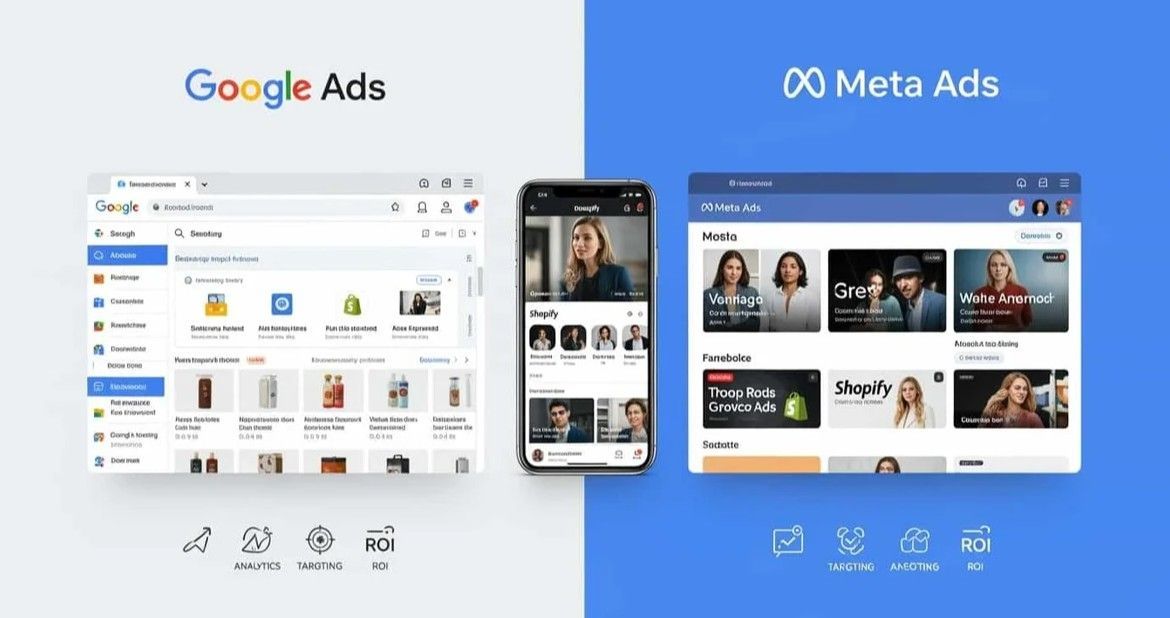
Meta Ads vs. Google Ads for SMB Growth
How to win more leads, sales, and brand recognition—while measuring ROI and scaling with confidence

The real problem SMBs face
(and why ad dollars get burned)
The issue : You need qualified leads now, steady sales this quarter, growing brand recognition this year, and the ability to prove your marketing is working so you can scale. But most campaigns deliver random clicks, not revenue.
Where it goes wrong:
- You boost posts or “try a few keywords” without a strategy. That creates vanity metrics (likes, impressions) instead of outcomes (form fills, booked jobs, sales).
- You pick only one channel—either Meta or Google—and leave gaps in the buyer journey.
- You can’t see what’s working in one place, so optimization lags and budgets drift.
Old tactics that waste money:
- “Post and pray” on social.
- Generic PPC with broad keywords and no conversion tracking.
- Set-and-forget creative that never gets A/B tested.
- No retargeting—so warm visitors go cold.
The new approach: run Meta and Google together
(by design, not by accident)
Think of Meta Ads (Facebook + Instagram) as your demand generator—where attention and interest are created with visuals and storytelling. Think of Google Ads as your demand capturer—where people with intent are actively searching and ready to convert. Used together, they move people from discovery → consideration → action with fewer leaks and more measurable wins.
What each platform does best (in plain English)
Meta Ads
- Who you reach: People by interests, behaviors, and demographics—even if they’re not searching yet.
- What it’s great at: Visual storytelling, social proof, and building brand memory that makes your offers feel familiar when buyers are finally ready.
- Best fit KPIs: Reach, ThruPlay/video views, engaged audiences, qualified lead volume via instant forms (with “Higher Intent” review steps), and assisted conversions.
Google Ads
- Who you reach: People who are searching right now—for your service, your solution, or your competitors.
- What it’s great at: Bottom-funnel conversions, pay-per-click efficiency, and high-intent leads from specific queries.
- Best fit KPIs: Cost per lead/sale, conversion rate, ROAS, phone calls, booked jobs.
How Do They Overlap, and Why Combine Them?
Meta excels at demand generation. It puts your brand in front of ideal customers before they start searching.
Google captures high-intent demand. When prospects look for your solutions, your ad is there—ready to convert interest into a lead or sale.
Used together, they guide customers from discovery to purchase, retargeting visitors at each step and maximizing every ad dollar through synergy rather than duplication.
Benchmarks (to keep expectations real)
- According to recent data, the overall average conversion rate (CVR) for Google Ads across industries is around 6.96%.
- In a dataset, Google Ads ROI was shown as ~8.17x pipeline for certain companies.
- Typical Google Ads benchmarks (Search vs Display): Search average conversion high, display much lower.
- Meta’s campaign objective architecture simplified in 2025: Awareness, Traffic, Engagement, Leads, App Promotion, Sales.
These numbers illustrate that combining platforms for different roles in the funnel tends to yield better overall efficiency and scale.
The “dual-engine” system: scenarios, mistakes, and the smarter plan
Below are five common SMB needs. For each, you’ll see: the issue, where most go wrong, and the strategy that works—with the exact KPIs to watch.
1) Lead Generation (form fills, calls, booked consultations)
Issue : You need qualified leads, not random inquiries.
Where it goes wrong: Running only Google (“instant leads!”) or only Meta (“cheap clicks!”) and ignoring retargeting.
A smarter plan:
- Meta (Top/Middle): Run educational short-form videos and problem-solution carousels to local lookalikes + interest stacks (e.g., homeowners for HVAC, new parents for dental, property managers for roofing). Use Lead Ads with “Higher Intent” (review step) to filter out low-quality form spam.
- Google (Bottom): Target exact-match and high-intent phrases (“emergency AC repair near me,” “roof leak repair,” “business IT support Houston”). Build call extensions, booking CTAs, and conversion tracking.
- Retargeting: Visitors who engaged or clicked but didn’t convert get shown testimonial clips, offer reminders, and FAQs across both platforms.
- KPIs to watch: Qualified cost per lead (CPL), form completion rate, call recording conversions, booked appointments, assisted conversions from Meta → Google.
- Expectation: Immediate lead flow from Google while Meta reduces cost per qualified lead by priming and retargeting.
2) Direct Sales (e-commerce or service prepayments)
Issue
: You want net new revenue, not just add-to-carts.
Where it goes wrong: Leaning only on Shopping or only on social promos; ignoring creative testing and offer sequencing.
A smarter plan:
- Google Shopping/Performance Max: Capture buyers ready to purchase; feed quality product data (titles, images, GTINs) and set ROAS targets.
- Meta: Run creative that creates demand—UGC, before/after, bundles, urgency (seasonal drops). Use Advantage+ Catalog Ads and creative testing to find thumb-stopping winners.
- Demand Gen (Google): Extend discovery across YouTube, Gmail, Discover to bridge the gap between Meta awareness and Google search intent.
- KPIs to watch: ROAS, new-customer % vs. returning, view-through and cross-channel assisted revenue.
- Expectation: Shopping/PMax closes; Meta + Google Demand Gen expand reach and lower blended CAC over time.
3) Brand Recognition (category leadership in your market)
Issue : You’re invisible to ideal buyers until they stumble onto a competitor.
Where it goes wrong: Only bidding on your brand name or running generic awareness posts without frequency control.
A smarter plan:
- Meta Awareness/Engagement: Run a 3-creative mix (story video, social proof carousel, founder message) to build familiarity.
- Google: Own your brand terms and protect SERP real estate. Layer YouTube for reach with skippable in-stream to reinforce your positioning.
- KPIs to watch: Ad recall (proxy via reach/frequency), brand search volume growth, branded CTR, direct traffic trend.
- Expectation: Lower future CPA because people already know (and trust) your name before they search.
4) Promotions (new services, seasonal offers, events)
Issue : You need fast attention—and fast action.
Where it goes wrong: One-and-done blasts. No pre-heat, no remarketing, no landing page alignment.
A smarter plan:
- Meta: Tease with countdowns, short product demos, and limited-time social offers. Build a promo-retargeting pool from engaged viewers and clickers.
- Google: Time-boxed campaigns on promo keywords + sitelinks to FAQs, warranty, and reviews.
- KPIs to watch: Promo-period revenue, incremental lift vs. baseline, add-to-cart and checkout starts, peak call volume by hour.
- Expectation: Faster ramp and higher take rate when Meta warms the audience and Google captures active promo searchers simultaneously.
5) Measurement & Scale (prove it works, then pour fuel on it)
Issue
: You can’t scale what you can’t measure.
Where it goes wrong: No unified source of truth, under-counted conversions, and “optimize by gut.”
A smarter plan:
- Track the full funnel. Configure conversions (calls, forms, purchases) on both platforms; import offline conversions where relevant.
- Benchmark realistically. Compare your CPC, CVR, CPL, ROAS to recent industry ranges; use them to set weekly targets and cut losers quickly. (See Google Ads benchmarks) WordStream+2Search Engine Land+2
- Scale what earns it. When your blended CAC ≤ target and lead quality is validated by sales, raise budgets in increments (e.g., +10–20%) to avoid algorithm shock.
A day-one execution map (you can steal this)
- Foundation (Week 1)
- Install pixels/tags, enable conversion tracking, set up call tracking, connect product feeds (if e-com), and define success KPIs.
- Launch Google Search/PMax on bottom-funnel terms and Meta Awareness/Leads to seed your warm audience.
- Creative & Offer Testing (Weeks 2–3)
- Test 3 angles: pain-point, proof/testimonial, value/offer.
- Add retargeting on both platforms for non-converters (7/14/30-day windows).
- Tighten Targeting (Weeks 3–4)
- Negative keywords and search term pruning on Google; audience stacking and Higher-Intent lead forms on Meta.
- Shift budget to the ad groups and creatives beating your CPL/ROAS targets.
- Scale (Month 2+)
- Expand near-match variants and new services/geos on Google.
- Add YouTube/Demand Gen and Advantage+ expansions on Meta to grow reach while holding efficiency.
What full transparency looks like with us
At Growth Reach Digital, you get 24/7 access to real-time reporting through customer dashboards—no black boxes, no mystery metrics. We bring big-agency tactics (cross-platform funnels, creative sprints, audience science, and continuous testing) to SMB budgets—with responsive customer care and a relentless focus on results. We’re BIG about results and BIG about keeping you in the loop every step of the way.
Quick FAQ (SEO-friendly, straight answers)
Is Meta cheaper than Google?
Often Meta’s CPC is lower, but intent is different. Meta shines at
creating demand and nurturing; Google excels at
capturing high-intent searches. Your best CPL usually comes from running both and optimizing the blend.
Which KPIs matter most?
For lead gen:
qualified CPL, call/booking rates, and close rate. For e-com:
ROAS, new-customer %, and contribution margin. Track assisted conversions so Meta doesn’t get under-credited for warming users who later convert via Google.
How fast will I see results?
Google Search can drive leads immediately once tracking is in place. Meta builds efficient reach and lowers blended CAC over several weeks as creative + audiences are dialed in. (Plan weekly optimizations; scale monthly.)
Bottom line
Meta vs. Google isn’t a fight—it’s a funnel. Meta creates and warms demand; Google captures and converts it. Combine them with clear KPIs, honest benchmarks, and weekly optimization, and you’ll stop wasting ad spend and start scaling with proof.
If you’re ready for a plan you can see working, we’ll build the funnel, run the tests, and hand you the dashboard. Growth Reach Digital—big-agency strategy, SMB pragmatism, and results you can measure.
Sources & References
- Meta Ads Manager: Choosing campaign objectives — https://www.facebook.com/business/help/1438417719786914 facebook.com
- Meta Ad Campaign Objectives (2025) — https://www.wordstream.com/blog/facebook-ad-objectives WordStream
- Meta Ad Objectives & How to Use Them — https://www.seerinteractive.com/insights/meta-ad-objectives-and-how-to-use-them Seer Interactive
- Choose the right campaign type (Google Ads) — https://support.google.com/google-ads/answer/2567043?hl=en support.google.com
- Google Ads – Get Customers and Sell More with Online Advertising — https://business.google.com/us/google-ads/ Google Business
- 2024 Google Ads Benchmarks: New Trends & Insights — https://www.wordstream.com/blog/2024-google-ads-benchmarks WordStream
- Google Ads Benchmarks 2024 (Alternative) — https://searchengineland.com/search-advertising-benchmarks-2024-440415 Search Engine Land
- Types of Google Ads in 2025 explained — https://www.channable.com/blog/types-of-google-ads-explained Channable