Why 70% of 'AI Visibility' Is just seo done right
TL;DR (too long, didn't read):
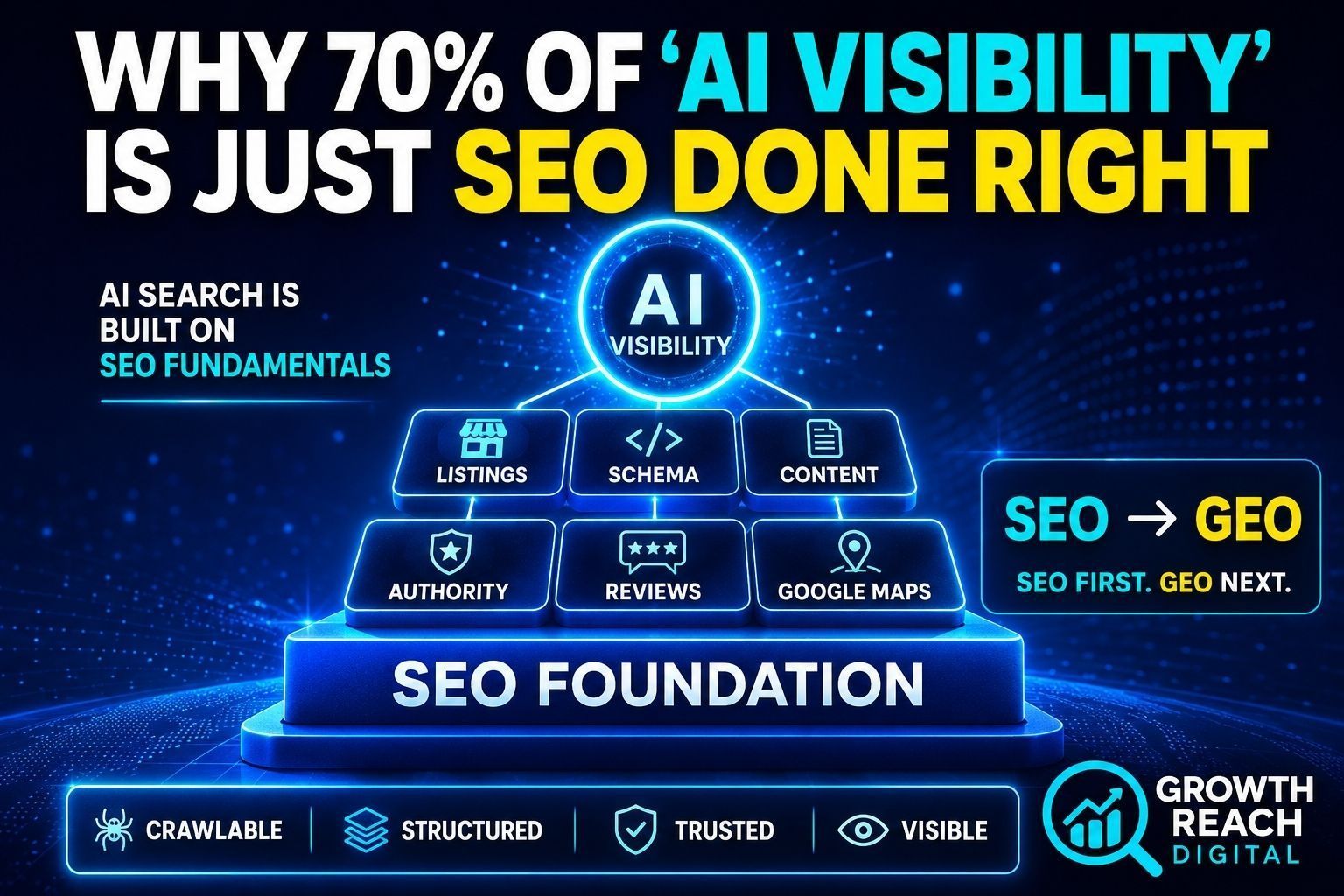
- AI-powered search isn't replacing SEO — it's built on top of it. Roughly 70% of what makes a business visible in AI answers is the same work that makes it visible in Google Search and Maps.
- Google Search and Google Maps still drive the vast majority of local, ready-to-buy traffic. AI tools like ChatGPT and Perplexity are mostly used for research right now, not for finding a plumber at 9pm.
- You can DIY parts of this: your Google Business Profile, basic listings cleanup, simple FAQ content. It breaks down once you need consistency at scale, technical schema, and measurement.
- Bottom line: build your SEO foundation first, then layer GEO strategically on top of it. Skipping the foundation to chase "AI visibility" is how businesses waste money.
seo
vs geo: why seo still comes first
Digital marketing is shifting fast. AI-driven answers. Google AI Overviews. ChatGPT recommendations. Fewer blue links. More synthesized responses.
But here’s the part most businesses are missing: SEO didn’t die. It became the foundation of everything.
At Growth Reach Digital, we don’t chase buzzwords. We build strategies that survive platform shifts. And right now, the businesses that win in both traditional search and AI-powered search are the ones with strong SEO fundamentals.
Let’s break this down clearly.
The Psychology of How People Actually Search
When someone wants to buy, they don’t browse. They search with intent.
- “Emergency plumber near me”
- “Best HVAC repair in Houston”
- “Roof replacement cost 2026”
- “Coffee shop open now”
These are not research queries. These are action queries.
According to Google:
- 76% of people who search for something nearby on their smartphone visit a business within 24 hours.
- 28% of those searches lead to a purchase.
That’s bottom-of-funnel intent — the kind hat pays the bills.
Search Engine Marketing (SEM) and local SEO dominate here because:
- Google Maps shows location, reviews, directions.
- Search ads capture ready-to-buy traffic.
- Organic results provide credibility.
- Reviews reinforce trust at the decision moment.
AI tools are growing — but when someone is choosing where to drive or who to call, Google Search and Google Maps are still the primary conversion engine.
That’s not opinion. That’s behavioral data.
Where GEO (Generative Engine Optimization) Fits In
Now let’s talk about GEO.
Generative Engine Optimization (GEO) is about getting cited or recommended inside AI-generated answers (like ChatGPT, Perplexity, or Google AI Overviews).
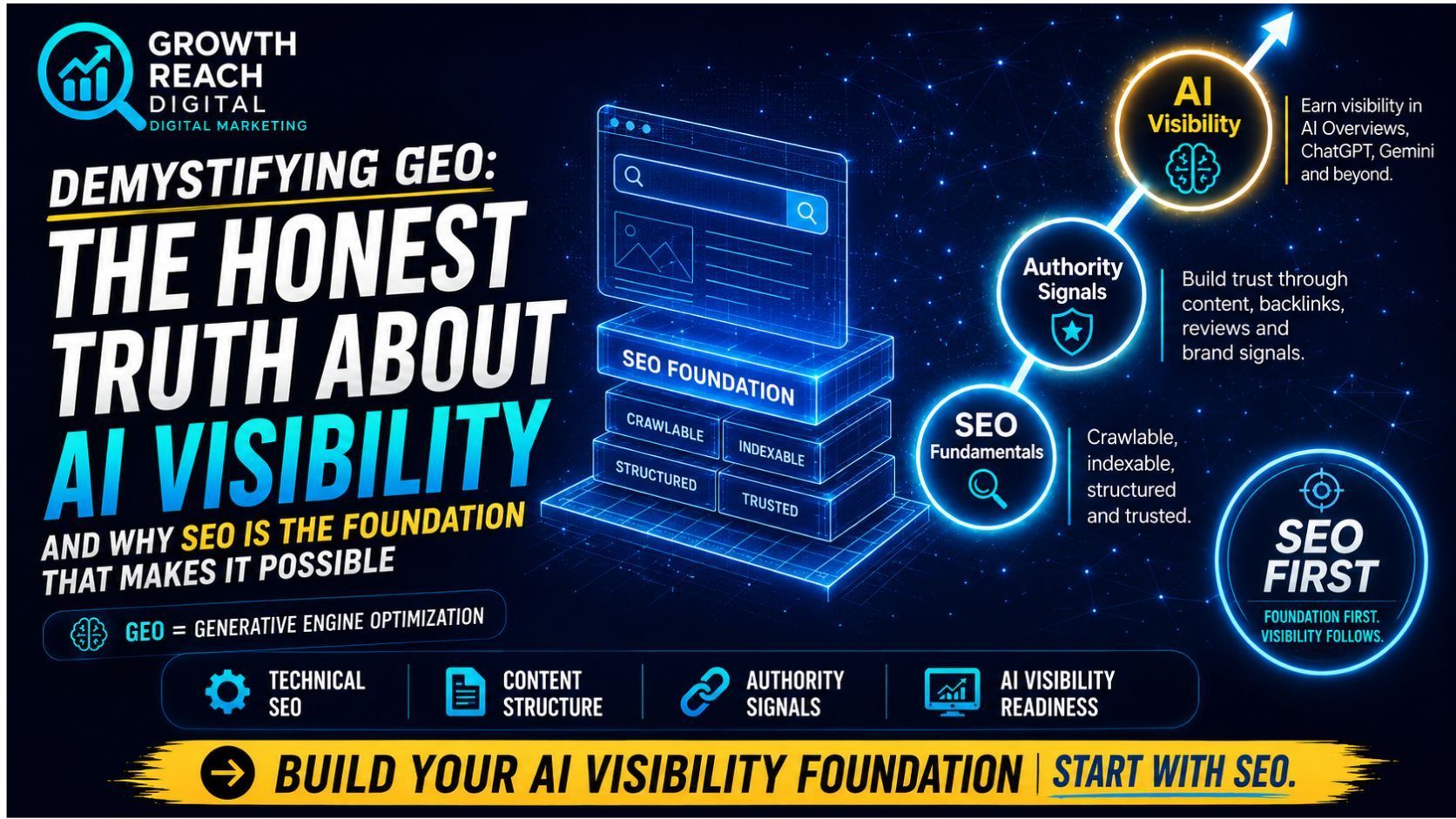
And here’s the truth most agencies won’t say: Roughly 70% of GEO overlaps with traditional SEO fundamentals.
The core GEO pillars AI systems rely on to trust and cite a business are the same ones Google has rewarded for years:
- Consistent listings (NAP accuracy)
- Schema markup
- Structured content
- Authoritative third-party mentions
- Question-based content
- Clear service pages
- Strong local signals
Sound familiar? That’s SEO.
What Actually Transfers from SEO to GEO
Let’s simplify it.
1. Listings Consistency = AI Trust Signal
AI engines cross-reference data. If your business name, address, or phone number is inconsistent across Google Business Profile, Yelp, Bing, and Apple Maps, AI may skip you entirely. Listings management — classic local SEO — is foundational GEO.
2. Schema Markup = Machine Readability
AI doesn't read pages like humans. It extracts structured information. Schema markup (LocalBusiness, FAQ, Service) acts like an API layer for AI systems. If you've invested in technical SEO, you're already building GEO infrastructure.
3. Question-Based Content = AI Citation Fuel
AI engines are trained to answer questions. Content structured like: direct answer first, supporting explanation, FAQ section, clear headings — performs better in AI synthesis. This is aligned with modern SEO best practices, especially structured service pages and FAQ optimization.
Again — overlap.
What You Can DIY — And Where It Breaks Down
Some of the above you can do yourself with a bit of time and organizational skills:
- Claim and fully complete your Google Business Profile — services, categories, hours, photos, and posts
- Manually clean up your NAP (name, address, phone) on your top 5–10 directories
- Ask every happy customer for a Google review, consistently, not just when you remember
- Add a basic FAQ section to your service pages answering the questions customers actually type into Google
- Add simple, plain-language descriptions to your service pages instead of vague marketing copy
If you have a free weekend and some patience, this is legitimate, worthwhile work. It moves the needle.
Where DIY breaks down:
- Consistency over time. A one-time listings cleanup drifts. Third-party data aggregators, changes in business information (opening hours, phone number), and even customer suggested content quietly re-introduce errors within 3–6 months, and most owners never check again.
- Technical schema. LocalBusiness, Service, and FAQ schema need to be implemented correctly in code to validate. Most DIY attempts on template site builders are incomplete or broken, which means AI and Google may ignore them entirely.
- Cross-platform monitoring. There's no easy way to catch NAP inconsistency across 20–60+ directories without tools built for it.
- Content structured for AI extraction. Most owners write like a brochure. AI rewards content written like an answer engine — direct, structured, specific.
- Measurement. Most owners have no way to actually track whether their visibility, rankings, or AI citations are improving. Without measurement, you're guessing.
DIY gets you a stronger starting point. It doesn't get you a system that compounds.
Is GEO Mostly Research While Google Drives Purchases?
AI tools are heavily used for research, comparisons, "explain this to me," "what's the difference between...," "how does this work?" → That's early-funnel behavior.
Meanwhile, Google still dominates high-intent transactional searches. Google processes over 8.5 billion searches per day (approximate industry consensus across reporting sources). ChatGPT has grown rapidly, but its primary use case remains informational and exploratory rather than local purchasing navigation.
When someone needs directions, a phone number, business hours, immediate availability, or reviews before driving — they go to Google Search or Google Maps. Both of these now answer questions through Google's own AI Gemini.
So the strategy is not “SEO vs GEO.” It’s: Build SEO foundations first. Layer GEO strategically.
The Strategic Model We Use at Growth Reach Digital
We approach visibility in layers.
Layer 1 — Search & Maps (High-Intent Conversion) Local SEO, Google Business Profile optimization, listings management, Google Ads, reputation management. This captures buyers.
Layer 2 — Structured Authority (AI & GEO Readiness)
Schema implementation, question-based content, FAQ markup, service page restructuring, citation authority building.
This builds AI visibility.
Layer 3 — Performance Amplification Search ads, YouTube, display, retargeting, Meta ads. This accelerates revenue.
Why SEO Is Still Foundational
If your SEO is weak, GEO will not save you. AI won’t trust inconsistent data. Your business won’t be cited. Google Maps won’t surface you. Ads will cost more due to weak landing pages.
But when SEO is strong:
- AI engines can extract your information
- Google (Gemini) trusts your data
- Your content answers questions clearly
- Your authority compounds across platforms
SEO is not old. It’s infrastructure!
The Real Risk for SMBs
Most small and mid-sized businesses are:
- Paying for SEO without clarity
- Running ads without conversion tracking
- Ignoring structured data
- Not measuring AI visibility
- Unsure what’s actually driving revenue
That uncertainty is dangerous in today’s environment — especially with AI layered on top.
Our Position as Your Strategic Partner
At Growth Reach Digital, we don’t sell trends. We build systems.
You get:
- Transparent pricing
- Senior-level oversight
- No mystery retainers
- Month-to-month flexibility on many services
- Clear reporting
- 24/7 dashboard access
- Strategy that evolves as platforms evolve
We don’t treat GEO as magic. We treat it as: SEO foundations + structured authority + measurable AI visibility.
What This Actually Costs — and How Long It Takes to Work
Two questions every owner has and most agencies dodge: what will this cost me, and when will I see it working?
Why pricing varies. The honest answer is that it depends on your starting point and your market. A single-location business with clean listings and light local competition needs less work than a multi-location business in a competitive metro with years of inconsistent data to clean up. Content and backlink needs vary the same way — a business with almost no existing content needs more built from scratch than one that just needs restructuring. Anyone quoting you a flat number before looking at your current visibility is guessing.
What actually drives the cost:
- Number of locations and service areas
- How competitive your market is
- How much existing content and backlink authority you already have
- Whether your listings are already clean or need a full cleanup
- Whether you want organic SEO alone, or SEO plus paid ads plus GEO layered on top
| Service | Cost Per Month | Purpose |
|---|---|---|
| Google Business Profile + Listings | $449 - $599 | Strengthens customer trust, NAP consistency, Google Maps visibility. |
| SEO | $799 - $2499 | Builds the technical, content, and local search foundation AI systems can crawl, understand, and reference. |
| High-Quality Backlinks | $399 - $949 | Builds authority, credibility, and third-party trust signals that support SEO and AI visibility |
Click below to see transparent Plans & Pricing details:
Timeline — what to realistically expect:
- Weeks 1–8: Foundation work — Google Business Profile optimization, listings cleanup, technical fixes. You may see early movement in Google Maps rankings if your profile was previously incomplete.
- Months 3–6: Organic search rankings typically start showing measurable movement as content and authority build.
- Months 6–12: Rankings and visibility compound, and this is usually where AI/GEO citation improvements start becoming noticeable, since they ride on top of the SEO foundation.
If anyone promises page-one rankings in two weeks or guaranteed AI citations, that's a red flag, not a shortcut.
where this becomes a Waste of Money
We'll say it plainly:
- Paying for GEO or "AI visibility" services before your Google Business Profile and listings are even consistent. You're optimizing for an advanced channel before the foundation exists to support it.
- Running search or social ads that point to a slow, unclear, or generic landing page. You'll pay more per lead and convert fewer of them, no matter how good the ad is.
- Treating AI visibility as your primary strategy when your business depends on local, urgent, "near me" traffic — most home service and healthcare businesses fall here, and Google Search and Maps are still where those customers convert.
- Buying backlinks or content with no connection to the questions your actual customers are asking. Volume without relevance doesn't build authority, it just adds noise.
Fix your foundation first. Everything you spend after that works harder.
The Bottom Line
- SEO drives visibility in Google Search & Maps
- SEM captures ready-to-buy traffic
- GEO expands presence inside AI-generated answers
- 70% of GEO best practices overlap with strong SEO fundamentals
- Google remains dominant for transactional and local purchasing behavior
- AI is expanding research behavior — not replacing purchase intent search (yet)
If you want to survive the next 5 years of search evolution: You don’t need a bigger budget. You need a better plan.
And it starts with foundations.
Ready to See Where You Stand?
Book a free strategy call with a Senior Strategist.
Let’s build a visibility strategy that works in Google Search, Google Maps, AI Overviews, ChatGPT, Perplexity, and whatever comes next!
Because the goal isn’t vanity metrics. It’s revenue for your business.
Growth Reach Digital — Turn Reach Into Revenue.
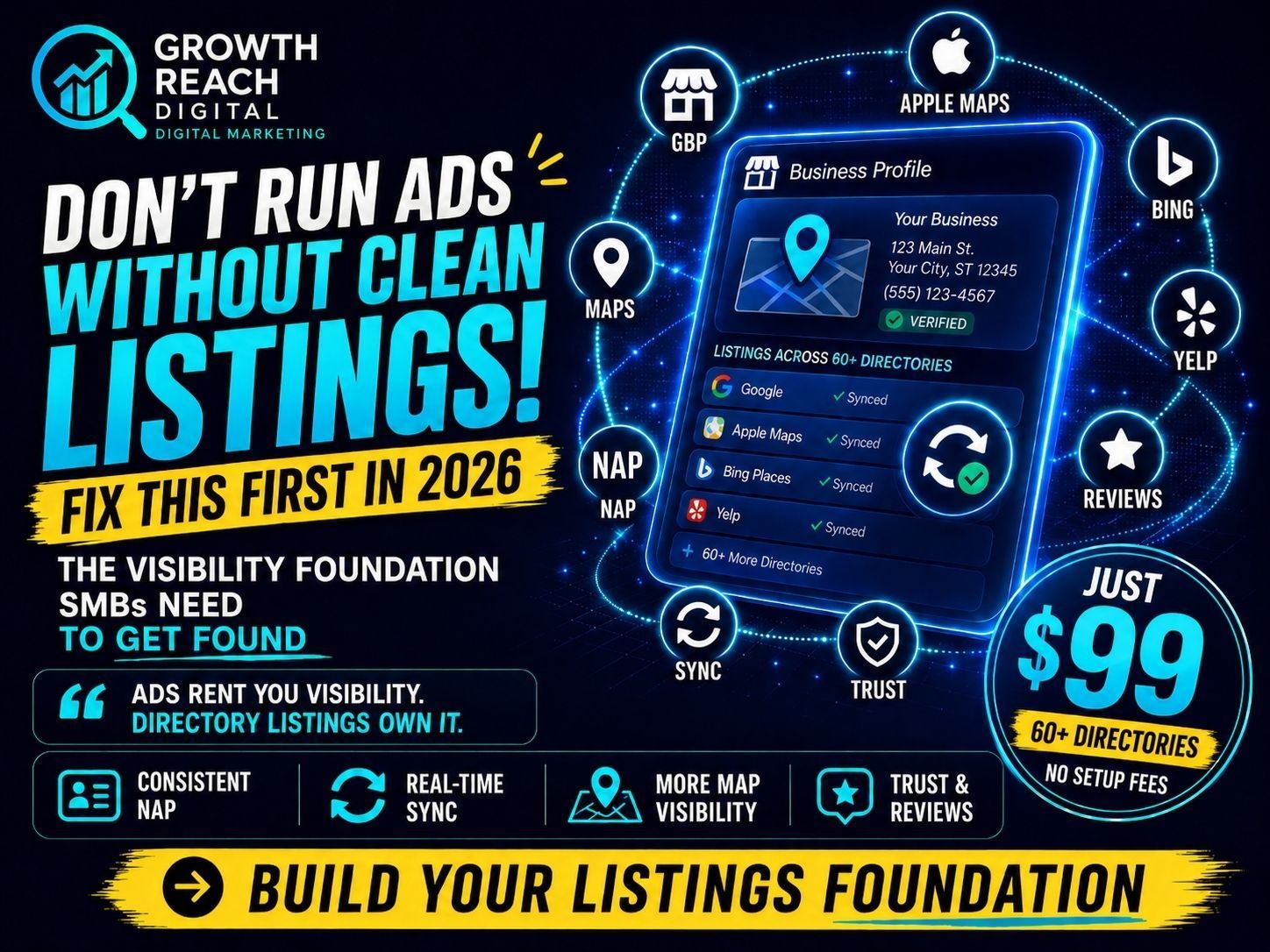
60+ Directory Listings for Just $99/month: The Minimum Your Business Must Do to Stay Visible in 2026