Meta Ads vs Google Ads for SMBs in 2026
Your Exact Full-Funnel Playbook Delivering 3–5x Blended ROAS
Meta just surpassed Google in global ad revenue for the first time in history. Here's what that actually means for your plumbing, roofing, HVAC, or local service business — and how to use both platforms together to generate consistent, measurable leads.
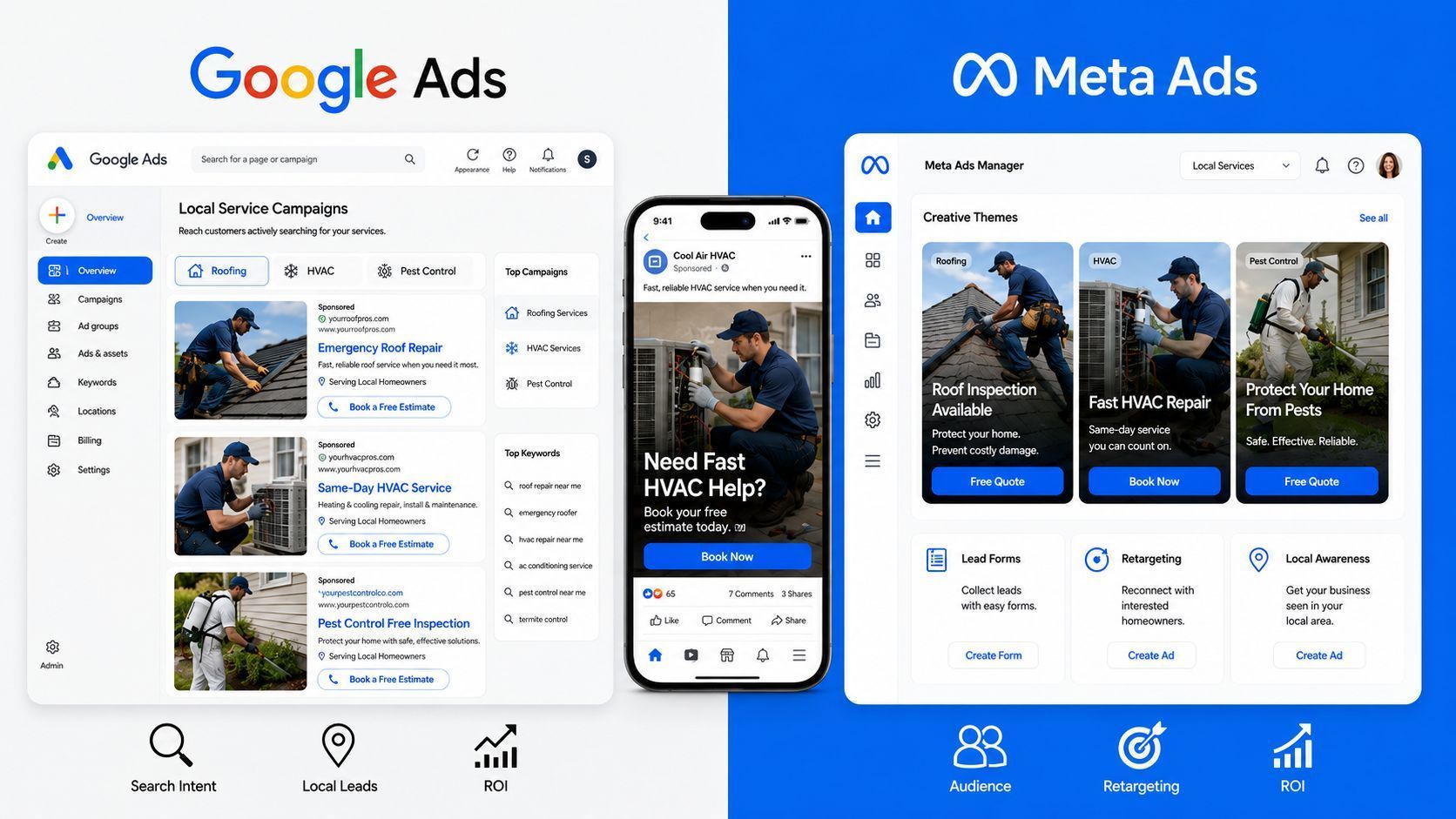
In 2026, the scoreboard finally flipped:
- Meta: $243.46 billion (+24.1% year-over-year growth)
- Google: $239.54 billion (+11.9% year-over-year growth)
Source: eMarketer, April 2026.
But here's the thing — you're not in the business of caring who wins the ad revenue wars. You're in the business of getting phone calls, booked jobs, and real ROI on every dollar you spend on advertising.
So let's talk about what actually matters: which platform should you be spending on, how much, and in what combination to get the best results for a local service business in 2026.
This post covers:
- Why Meta's explosive growth changes the game for small businesses
- 2026 benchmark data: CPC, CPM, conversion rates, CPL, and ROAS compared head-to-head
- Exactly when to use Google vs. Meta (and when to use both)
- A 7-step full-funnel playbook you can start implementing this week
- How much this realistically costs
Let's get into it.
Why the Rules Changed in 2026
Meta's rise to the top didn't happen by accident. Three things drove it:
Advantage+ automation got genuinely good. Meta's AI-powered campaign system now rivals Google's Performance Max in efficiency, and in many cases beats it on cost per lead for local service businesses.
Reels changed the creative game. Short-form video is now the highest-performing ad format on Meta, and for trades and home services businesses, nothing builds trust faster than a 30-second clip of your crew on the job.
First-party data got more valuable. As third-party cookies continue to phase out, Meta's logged-in user data and Google's first-party signals have become the backbone of effective targeting — which is exactly why both platforms are investing heavily in AI-driven automation.
Meanwhile, Google still owns something Meta can't touch: high-intent search. When someone types "emergency AC repair near me" at 10 PM on a Tuesday, they are ready to spend money right now.
The smartest local service businesses aren't debating which platform is better. They're using both — each doing the job it's built for.
2026 Benchmarks: Meta vs. Google Head-to-Head
Here's the honest data for local service businesses. No spin, no platform favoritism.
| Metric | Google Ads | Meta Ads | Edge |
|---|---|---|---|
| CPC | $2.69-$5.26 (Search) | $0.60-$1.20 | Meta (cheaper volume) |
| CPM | $38-$55 | $9-$16 (US avg ~$23) | Meta |
| Conversion Rate | 4.2-7.04 | 1.8-3.5% | Google (higher intent) |
| Cost Per Lead | $45-$85 | $18-$40 | Meta |
| Typical ROAS | 3.8-5.2x (PMax) | 2.8-4.5x (Advantage+) | Both: 3-5x blended |
What does this table tell us? Google converts better because the people clicking already want what you sell. Meta generates leads cheaper because you're reaching a much larger pool of people at a lower cost — including people who didn't know they needed you yet.
Neither platform wins outright. Together, they're a full-funnel machine.
When Google Ads Wins for Local Businesses
Google is your closer. Use it when:
- Someone is actively searching for your service right now ("plumber near me," "emergency AC repair The Woodlands," "roof inspection after storm")
- You need bottom-funnel conversions and fast sales cycles
- You want to leverage Local Services Ads alongside your Google Business Profile for maximum real estate on the results page
If you only have budget for one platform and your business depends on capturing demand that already exists — a plumber, electrician, or HVAC company serving urgent needs — Google is where you start.
See how we build Google Ads campaigns for local service businesses →
When Meta Ads Wins for Local Businesses
Meta is your pipeline filler. Use it when:
- You want to stay top-of-mind in your service area before someone needs you
- You're running Reels showing your crew, your work, and customer testimonials (this builds extraordinary trust over time)
- You want to generate reviews that strengthen your Google Business Profile and help you appear in Google AI Overviews
- You need cheaper cost per lead and powerful retargeting — following up with website visitors, video viewers, and past customers automatically
For businesses like pest control, roofing, landscaping, and HVAC maintenance plans — where the decision isn't always urgent — Meta is where you build the relationship before the competitor even enters the picture.
See how we build Meta Ads campaigns for local service businesses →
The Exact 7-Step Full-Funnel Playbook (2026 Edition)
This is the same framework we use with our clients. No gatekeeping.
Step 1: Set Up Bulletproof Tracking
Before you spend a dollar on ads, your tracking needs to be airtight. That means:
- Conversions API on Meta + Enhanced Conversions on Google
- Offline conversion uploads (phone calls and completed jobs, not just form fills)
- GA4 as your single source of truth across both platforms
Most SMBs skip this step and end up optimizing toward the wrong signals. Don't.
Step 2: Choose the Right Budget Split
This is the most common question we get, and the honest answer depends on your total monthly spend:
- $500 – $1,500/month: 70% Meta / 30% Google. Build awareness and generate affordable leads while capturing high-intent searches.
- $2,000 – $5,000/month: 60% Meta / 40% Google. Increase your Google footprint as you scale.
- $5,000+/month: Add YouTube pre-roll and Performance Max testing. Now you're playing full-funnel at a serious level.
Step 3: Use Meta for Demand Creation
Run Advantage+ campaigns and commit to creative refresh. The number one mistake we see on Meta is running the same three creatives for three months and wondering why performance dropped.
Aim for 10–20 new creatives every month. UGC-style Reels — filmed on your phone, real jobs, real results — consistently outperform polished studio ads for local service businesses.
Step 4: Use Google for Demand Capture
Focus your Google budget on Search and Performance Max with tight local intent keywords. Pair every ad with a strong service landing page — not your homepage. Someone searching "water heater replacement near me" should land on a page dedicated to that exact service, with your pricing, process, and a clear CTA.
Step 5: Cross-Platform Retargeting
This is where the compounding happens. Feed warm Meta audiences (video viewers, website visitors, lead form openers) into Google Customer Match lists. Now the person who watched your HVAC Reel on Instagram starts seeing your Google search ads too. The multiple touchpoints do the closing work for you.
Step 6: Measure Blended ROI
Stop celebrating platform-reported ROAS. Both Meta and Google overcount their own contribution. The only numbers that matter are real business results: calls booked, jobs completed, revenue generated. Track blended ROAS across both platforms together. A 3–5x blended return is a realistic, achievable target when the system is built correctly.
Step 7: Scale with Automation Guardrails
Let the AI do the heavy lifting on bidding and audience optimization — that's genuinely where these platforms have gotten very good. But review creatives weekly, keep testing new angles, and never let a campaign run on autopilot for more than 30 days without a human looking at it.
How Paid Ads Supercharge Your SEO and GEO
One thing that gets overlooked: paid ads don't just generate leads directly. They also strengthen your organic presence.
More website traffic from Meta and Google ads means more behavioral signals for Google's algorithm. More leads mean more customers, which means more Google reviews. More reviews and engagement signals mean better visibility in Google Business Profile and — increasingly important in 2026 — in Google's AI Overviews.
Strong SEO and GEO (Generative Engine Optimization) foundations amplify your paid results, and paid ads amplify your organic authority. They're not separate strategies. They're the same flywheel.
Common Mistakes We See SMBs Making Right Now
- Trusting platform-reported ROAS at face value. Both platforms take credit for conversions that would have happened anyway. Look at blended numbers and offline conversions.
- Not refreshing Meta creatives often enough. Creative fatigue on Meta is real and fast. If you're not producing new content consistently, performance will decay.
- Running only one platform. The full-funnel approach consistently outperforms either platform alone. Google captures. Meta builds. Together, they compound.
- Setting up tracking as an afterthought. If your tracking is broken, your AI bidding is optimizing toward the wrong goals. This is the most expensive mistake on this list.
Ready to Stop Guessing and Start Getting Consistent Leads?
At Growth Reach Digital, we build full-funnel paid media systems that combine Meta, Google, and your organic presence into one predictable, measurable growth engine.
Senior-led strategy. Transparent pricing. White-glove service built specifically for small and medium-sized local businesses.
We show our prices upfront — no sales games, no mystery proposals.
Explore our Google Ads plans and pricing →
Explore our Meta Ads plans and pricing →
If you want to understand the full picture first, start with our service pages:
Google Ads for Local Businesses · Meta Ads for Local Businesses
Last updated: June 2026
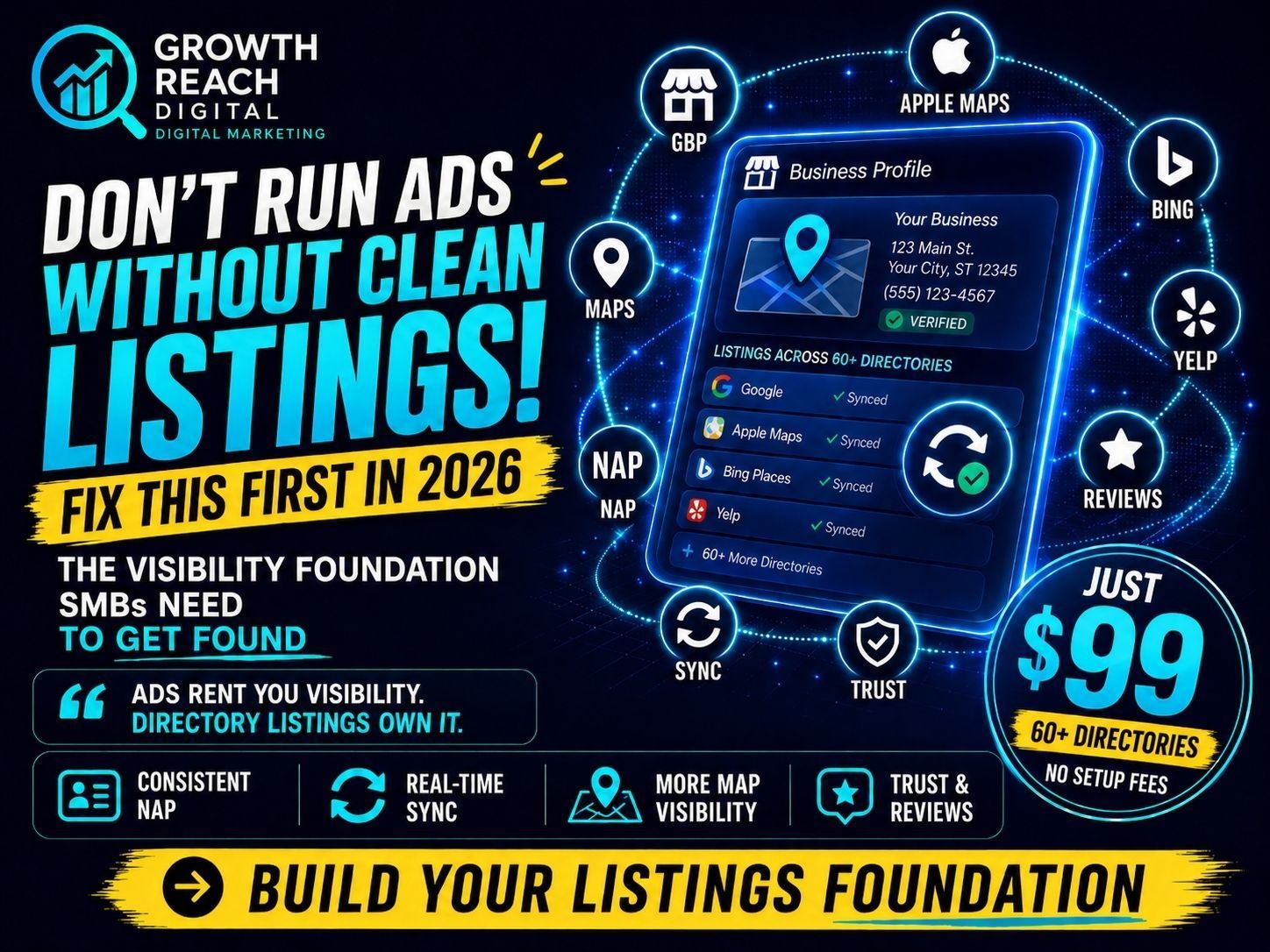
60+ Directory Listings for Just $99/month: The Minimum Your Business Must Do to Stay Visible in 2026