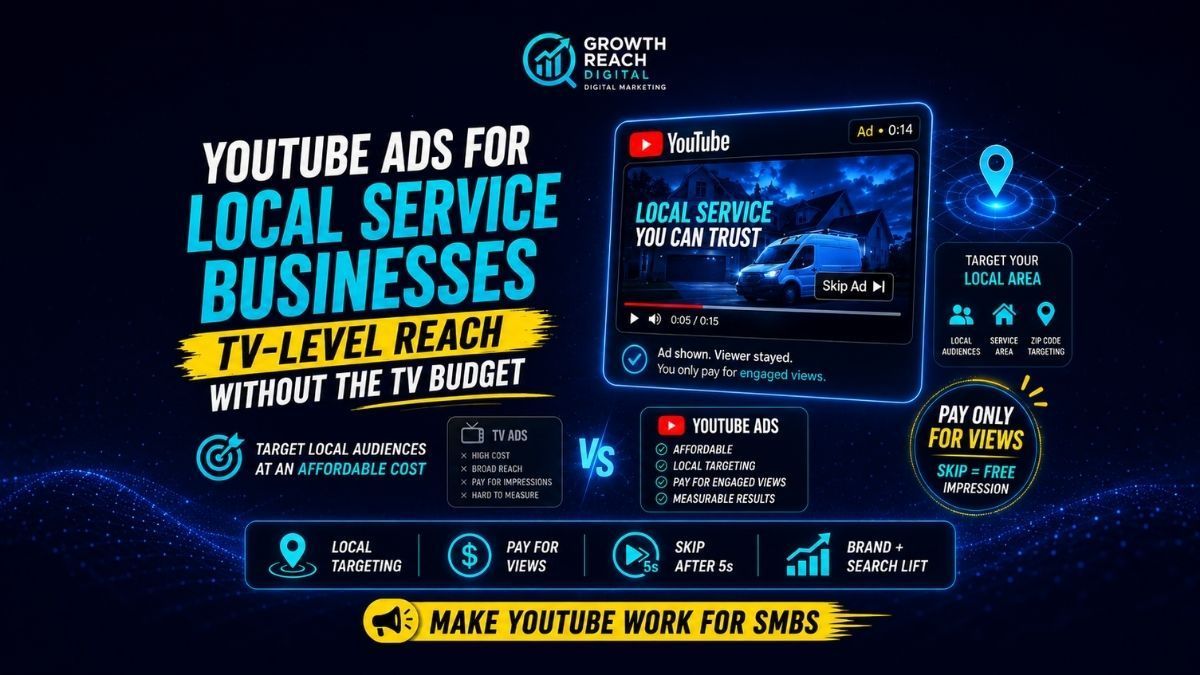
YOUTUBE ADS FOR LOCAL SERVICE BUSINESSES: TV-LEVEL REACH WITHOUT THE TV BUDGET
TL;DR (too long, didn't read):
- TV charges you for every eyeball, watching or not.
- YouTube only charges you for the eyeballs who actually stuck around to watch for 30 seconds (or the whole ad, if it's shorter) – or if they clicked.
- If they skip, you pay nothing!
- A case study published on 'Think with Google' cites a retailer who added YouTube to its media mix and reported a 7% increase in ad reach at 80% lower cost per view compared to TV.
- The crux of the story is: local service businesses can reach a highly targeted audience at an affordable cost.
Read on to find out:
- What YouTube ads actually cost in 2026 — real numbers, not rounded-up marketing math
- Why the skip button is your friend, not your enemy
- When to run these yourself, and when they need a professional hand
- What most agencies won't tell you about what these ads can't do
TV Commercials Used To Be a Big-Budget Club. Not Anymore.
Not long ago, if you wanted your business on a screen, you needed real money — a five-figure production budget, a media buy negotiated in blocks of thousand-dollar spots, and no real way to know who actually saw your ad or whether it did anything.
Local TV still isn't cheap. Depending on market size and time slot, a 30-second local spot typically runs a cost-per-thousand-impressions (CPM) of $15 to $35, with $20-25 being the most commonly cited average. National broadcast runs higher, often $20 to $50 CPM. And that's just airtime — you pay it whether the viewer got up for a snack during your ad or watched every second.
YouTube skippable ads work differently. You set a budget, you choose who sees the ad — age, location, interests, even people who've already visited your website — and you only pay when someone actually watches 30 seconds (or the whole thing, if it's shorter) or clicks.
Viewer skips at second 14? You paid nothing.
Yet they still saw your logo, heard your first few words, and it cost you zero dollars.
What These Ads Actually Cost in 2026
This is the number every business owner actually wants, so here it is straight, without rounding it into something more dramatic than it is.
Cost per view (CPV) — what you pay per engaged viewer — commonly runs $0.02 to $0.12, depending on your industry and how tightly you target. Broad consumer categories sit at the low end. Competitive, high-value fields like legal, financial services, and specialty contracting sit at the higher end, because more advertisers are bidding for the same audience.
Cost per thousand impressions (CPM) for skippable in-stream ads generally runs $5 to $15 — compared to $15-35 for local TV and $20-50 for national broadcast.
That's a real, meaningful gap — roughly half to a third the cost of reaching the same number of eyeballs — but it's not the "1% of the cost" some ads make it sound like. Be skeptical of anyone (including us, if we ever get sloppy) who quotes you a number that sounds too good to check.
What a Realistic Monthly Budget Looks Like for a Local Service Business
Forget national case studies for a minute. Here's the number that actually matters: what should you — running ads in one city, not across a country — expect to spend, and what does that money actually get you?
The realistic range for a first real test is $750 to $1,500 a month — industry guidance across paid video platforms consistently lands local/small business test budgets in that range. Below that, you're mostly paying tuition to the algorithm's learning phase rather than collecting data you can act on.
Here's what that buys, in plain math using the CPV range above:
- Home services categories (HVAC, plumbing, roofing, electrical, pest control) tend to sit toward the lower-to-middle end of that range, roughly $0.03-$0.06 per view. A $750 budget gets you somewhere around 12,500 to 25,000 engaged views in your service area. At $1,500, that's roughly 25,000 to 50,000 views.
- Higher-value professional services (attorneys, healthcare) tend to sit toward the higher end, roughly $0.06-$0.12 per view, because more advertisers compete for that audience. A $750 budget gets you around 6,000 to 12,500 views; $1,500 gets you 12,500 to 25,000.
What that budget does NOT buy: a fixed cost per lead. This is where business owners who are used to shopping for Google Search ads or Local Service Ads get tripped up, because cost per lead is the number everyone quotes there. For comparison, 2026 benchmarks put the average cost per lead for HVAC and plumbing Google Search ads at roughly $80 to $180, and Local Service Ads leads typically run $40 to $85 depending on trade. Those numbers exist because Search and LSAs capture someone who has already decided to call somebody today.
Video doesn't work that way, and it's not supposed to. There's no equivalent "cost per lead" number to shop for here, because a view isn't a lead — it's someone who now recognizes your name the next time they search for your service, see your listing, or get a referral from a neighbor. Judging a video campaign against a Search cost-per-lead is judging it by the wrong yardstick, and it's the most common reason a business owner runs video once, doesn't see an instant lead number, and writes the whole channel off.
A realistic timeline: Google's own learning phase typically takes about a week to stabilize. Give the campaign 3 to 4 weeks before you judge creative and targeting, and 2 to 3 months before you evaluate whether it's actually moved your branded search volume, direct calls, or Google Business Profile activity. If anyone promises fast, cheap, trackable leads from video alone in week one, that's worth a second question.
What a working budget actually changes:
- Your service area sees your name and face repeatedly, not once
- Branded search — people typing your business name instead of "plumber near me" — tends to climb over a few months
- Your Search ads, GBP, and retargeting all get a lift, because people click and call names they already recognize
If the goal is cheap leads fast, that budget is better spent on Search or Local Service Ads. If the goal is building the kind of recognition that makes every other marketing dollar work harder, that's exactly what this budget is for.
(For what it's worth: this isn't just a small-business theory. Dutch retailer HEMA ran the same logic at scale — adding YouTube to its TV mix and measuring a 7% increase in reach at 80% lower cost per view than television, per a published Think with Google case study. Same mechanism, bigger checkbook.)
Why the Skip Button works in your favor
"The viewer can skip after 5 seconds" isn't a downside at all; here's why: Every skip is a free impression. Someone saw your logo, heard your opening line, and moved on — and you paid nothing for it. The people who don't skip are, by definition, people who found those first 5 seconds interesting enough to keep watching. You're not paying to interrupt uninterested people. You're paying only for attention that was actually given.
The Common Misunderstanding: "More Reach Automatically Means More Calls"
Here's the part most agencies gloss over, because it's less fun to say than "TV-level reach for pennies."
YouTube ads are a reach and consideration tool, not a direct-response tool in the way Google Search ads are. Someone searching "emergency plumber near me" has already decided to call somebody today. Someone watching a YouTube video hasn't necessarily decided anything — your ad is planting a seed, not closing a sale.
What to realistically expect:
- Increased brand recognition and recall in your service area
- Better performance from your other channels — people who've seen your video ad are more likely to recognize your name in a Google search or on a directory listing later
- Solid results when paired with retargeting, so people who watched your video see your search ads or Google Business Profile again later
What NOT to expect:
- Phones ringing off the hook the day your campaign launches
- Video ads outperforming Search ads on immediate call volume
- Results without a real destination — a landing page, a Google Business Profile, or a phone number the viewer can actually act on when they're ready
If your visibility foundation — your Google Business Profile, your listings, your website — isn't solid yet, a YouTube ad is sending interested people into a dead end. Foundation first. Video amplifies what's already working; it doesn't fix what isn't.
Can You Run These Yourself?
If you have the time and patience to learn Google Ads' video campaign structure, yes — the self-serve tools are genuinely accessible now in a way they weren't a decade ago. Here's the honest DIY path:
Step 1: Set up conversion tracking first. Before you spend a dollar on video, make sure you can measure a call, a form fill, or a booking back to the campaign. Skipping this step is the single most common way businesses waste video ad budget — they can't tell if it worked.
Step 2: Start with a real test budget. Industry guidance for a local service business puts an effective monthly test budget around $500 to $1,500 — enough to exit the platform's early learning phase and get data you can actually act on. Below that, you're mostly paying to find out the platform exists.
Step 3: Build a genuine hook for the first 5 seconds. This is the single highest-leverage thing you control. If your ad doesn't earn the next 25 seconds in the first 5, you'll pay non-skippable-level prices for skippable-level attention — because you'll need far more impressions to get the views you're paying for.
Step 4: Layer your targeting carefully. Location, service-area radius, age range, and interest categories all matter. Too many targeting conditions can throttle delivery and drive your cost per view up rather than down.
Step 5: Watch it weekly and be willing to kill weak creative fast. A video that isn't earning view-throughs by week two rarely turns around on its own.
DIY Mistakes to avoid
Business owners run into trouble not at setup, but at optimization.
Video advertising has more moving parts than a search campaign: creative testing, audience layering, device and placement exclusions (Connected TV audiences behave very differently than mobile audiences), and bid strategy selection, all while your day job is running plumbing crews or seeing patients, not adjusting Target CPV bids.
If you're making one or more of these mistakes on YouTube ads, you're getting burned:
- Not optimizing your video ad for the 5-second hook window before the viewer can click away
- Never built a landing page or clear next step, so interested viewers had nowhere to go
- Set a budget too small to leave the learning phase, then concluded "video doesn't work for us" — if your budget is less than $500, rather invest it in Meta or regular Google paid ads
How Growth Reach Digital Approaches This
We build and manage YouTube video campaigns as part of a broader Google Ads strategy — because a video ad without a search and Google Business Profile foundation underneath it is reach with nowhere to land.
We said transparent pricing, always — so here's the actual number, not a "request a quote" wall.
For monthly ad spend under $2,500 — which covers the realistic test range for most local service businesses outlined above — our management fee runs on a straightforward sliding scale based on commitment length. You can pay monthly, or prepay for a lower effective rate:
| Commitment | Billed Monthly | Paid Upfront |
|---|---|---|
| 1 month | $799/mo | $799 (same either way) |
| 3 months | $749/mo | $699/mo — $2,097 total |
| 6 months | $699/mo | $599/mo — $3,594 total |
| 12 months | $649/mo | $499/mo — $5,988 total |
That fee is separate from your ad spend, which goes directly to Google. You always know exactly what's paying for reach and what's paying for strategy — no bundled markup hiding inside your media budget, and no percentage-of-ad-spend fee that quietly grows every time you increase your budget.
One more thing worth knowing before or while you shop this around: a lot of agencies won't take on a video or paid ads client below a minimum monthly ad spend — often $1,500 to $3,000, sometimes higher. We don't have one. If your realistic test budget is $750 a month, that's a real engagement here, not a "call us once you're bigger" conversation.
In plain terms: a business testing at $750/month in ad spend and paying month-to-month is looking at roughly $1,549/month all-in. Prepay a year instead, and that same $750 ad spend brings your all-in cost down to $1,249/month — you're simply paying the $5,988 management portion upfront instead of spreading it out. At $1,500/month in ad spend, that's $2,299/month all-in on monthly billing, or $1,999/month all-in with a 12-month prepay.
If you're scaling past $2,500/month in ad spend, pricing shifts to reflect the added optimization work at that level — that's a real conversation for your specific numbers, not a rate we'd guess at here.
When you work with us on this, you get:
- Strategy built around your actual budget — not a one-size-fits-all package, because a $0.10 CPV legal client and a $0.03 CPV home services client need very different strategies and plans
- Creative guidance focused on the first 5 seconds — the single biggest lever in this format
- Real-time reporting so you know your cost per view, cost per lead, and what it's actually doing for your business — not just view counts
- A campaign that works alongside your Search ads and organic visibility, not in isolation
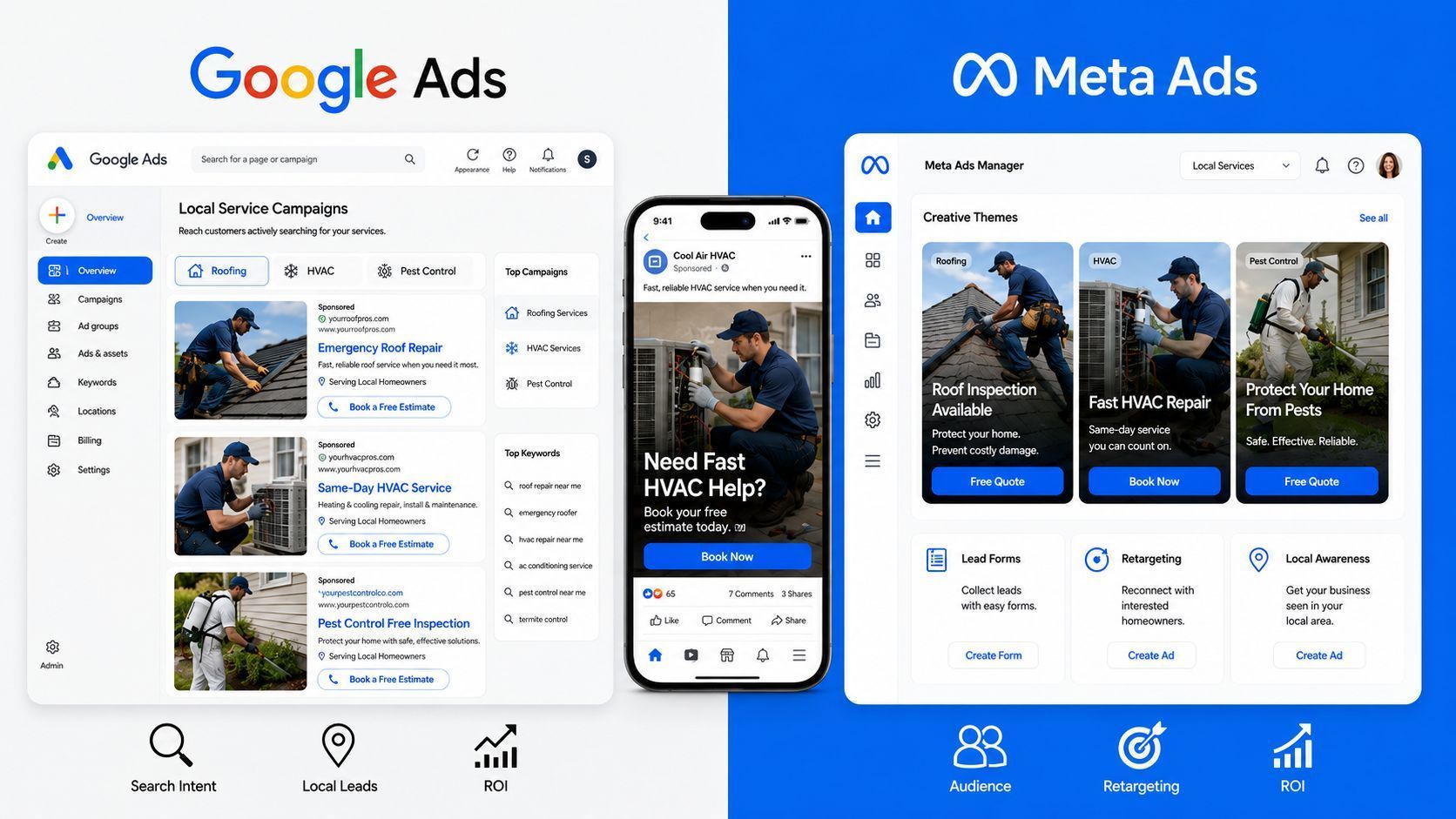
If you want to see how YouTube video fits into a complete paid ads strategy — including how it compares to and complements Google Search and Meta ads — we broke that down in detail in our Google Ads vs. Meta Ads playbook for local businesses.
Why This Matters Right Now
Search costs keep climbing.
Google Search CPCs have continued rising annually as more advertisers compete for the same searches. Video remains one of the more efficient ways to build the brand recognition that makes your other channels — Search, GBP, retargeting — perform better and cost less over time. If your search costs have crept up and your close rate hasn't, video is one of the few levers that helps without asking you to outbid competitors on the same keywords.
The Bottom Line
Skippable YouTube ads give small and local service businesses something that used to require a TV budget: real reach, real targeting, and a bill that only counts people who actually paid attention. The gap versus TV isn't the "1% of the cost" some marketing decks claim — it's more honestly a 50-80% cost efficiency gain, backed by real, published data. That's still a very good trade.
What it isn't is a replacement for the foundation. Video amplifies a business that's already findable and trustworthy. It doesn't fix one that isn't.
Curious whether YouTube ads make sense for your budget and your industry's CPV range? Schedule a free strategy call and we'll walk through real numbers for your business — no pressure, no canned pitch.
Growth Reach Digital serves local service businesses — plumbers, roofers, HVAC, electricians, pest control, healthcare, attorneys, and more — with senior-level digital marketing strategy and transparent pricing, always.
Sources referenced: Google Ads Help (official video ad format and billing documentation); Think with Google (HEMA case study); cross-industry 2026 YouTube ad benchmark aggregates (DigitalApplied, Store Growers, Stackmatix, Veefly, LocaliQ); 2026 local/national TV advertising cost guides (MNTN, Vidico, Simulmedia); 2026 HVAC/plumbing Google Search and Local Service Ads cost-per-lead benchmarks (SearchLight Digital).
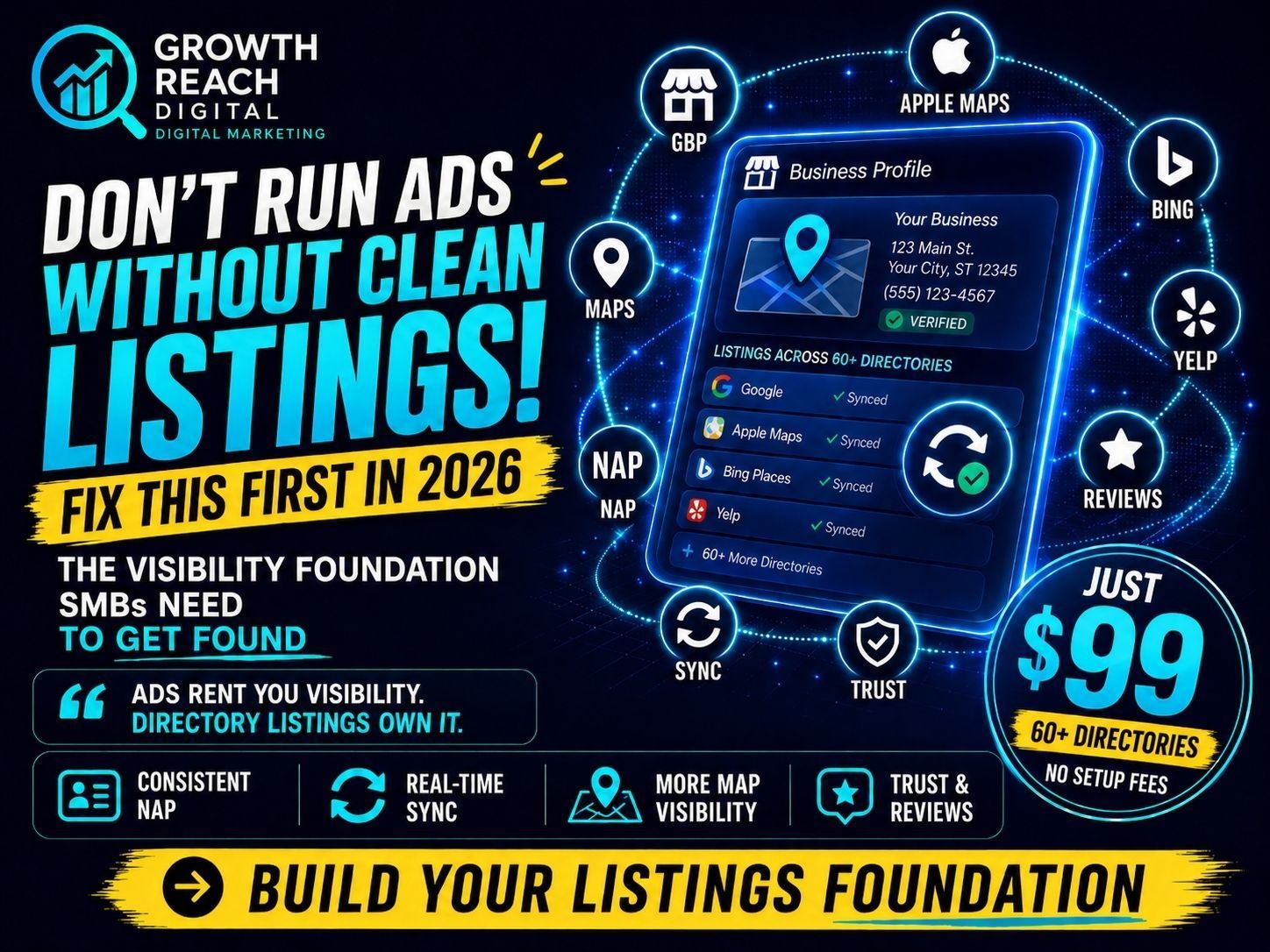
60+ Directory Listings for Just $99/month: The Minimum Your Business Must Do to Stay Visible in 2026