Don't spend MONEY on ads before you do this: The Minimum Your Business Must Do to Stay Visible in 2026
TL;DR (too long, didn't read): When you serve Google, Meta or TikTok ads for your local service business, one of the first things your potential customer does is to verify you're a real, trustworthy business. They Google your name (or better yet, use ChatGPT, Grok, Claude or Gemini) and the search engine crawls websites including dozens of directories that contain your business name, address, and phone number.
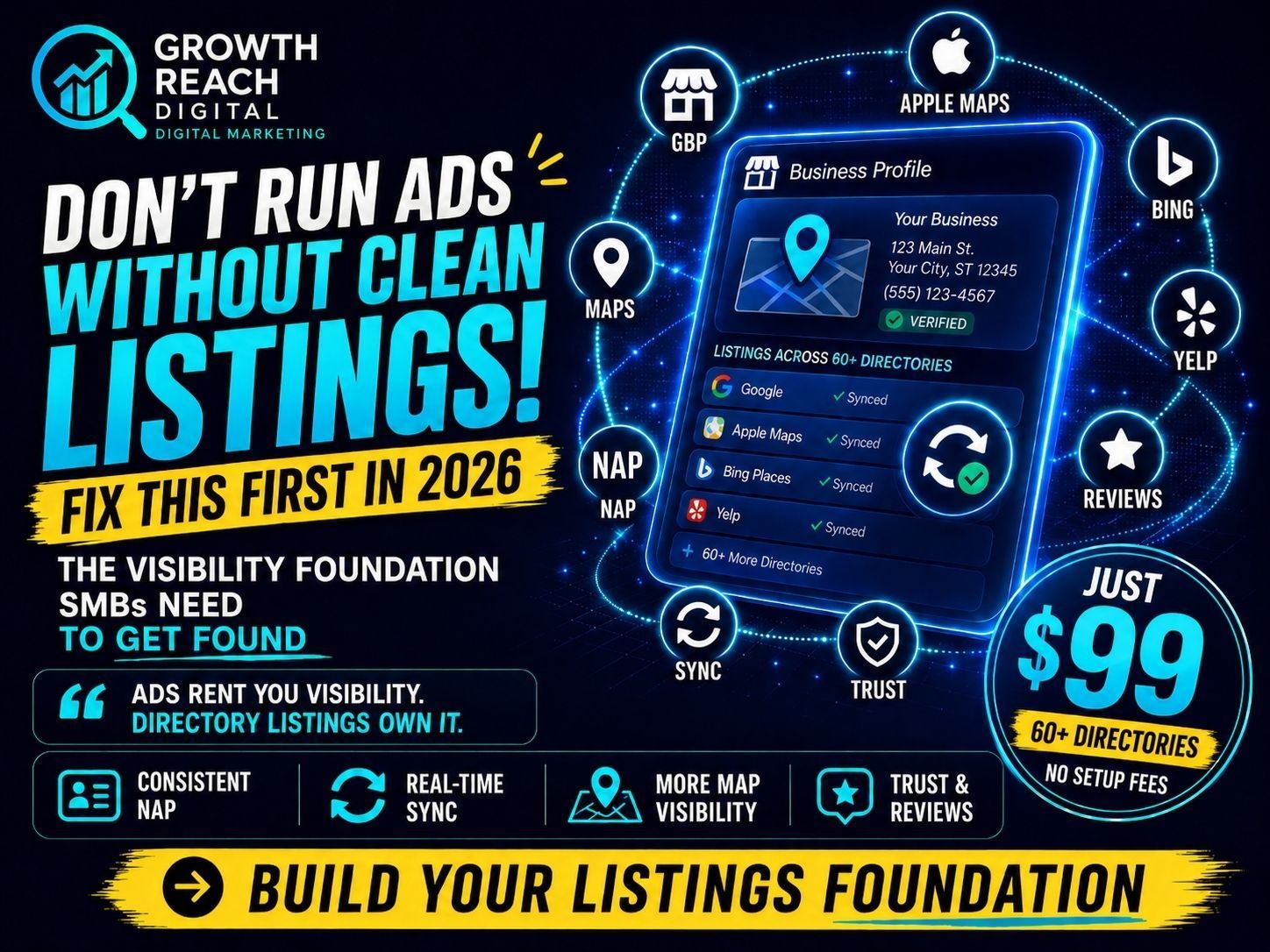
Ads rent you visibility, directory listings own it. Running ads without clean listings is like running a billboard campaign for a store with no sign on the door.
When those listings aren't identical, you're going to rank lower.
Solution 1: Clean up your own directory listings - it's free and straightforward in theory... but you'll spend hours each month.
Solution 2: Get Growth Reach Digital to do it for you. No setup fees, no manual updating, no headaches. All for $99 or less per month.
Read on to find out:
- Why 60+? Aren't 5 directories enough?
- Exactly how to do fix listings yourself
- Which businesses need this — and which don't
- The most annoying thing about listings management
- How to get the most out of your marketing budget
If you run a local service business — whether plumbing, HVAC, roofing, electrical, pest control to name a few — you already know the phone doesn't ring by accident. Every call, every booked job, every new customer came from somewhere. And in 2026, more of those somewheres are online than ever before.
You know exactly what happens when you press a 3M Command Hanging Strip on a dirty surface. The adhesive is not the reason it doesn't stick. In fact, the strips are of excellent quality – like your Google ads – but when you forget to clean the surface, you can't expect to get your money's worth.
Put yourself into your customer's shoes. You're served an ad for a service you need. What answer are you consciously and subconsciously looking for before you reach out?
Can I trust them to solve my problem? → I'll ask Google, ChatGPT, and the like.
Faced with a search prompt that includes a business name, what does the search engine do?
- It crawls dozens of directories (like Google Business Profiles, Bing, and Yelp) so it can rank and list all the business names similar to yours in your area.
- It ranks them in the order it trusts that the business information is accurate.
This is crucial: If your business name, address, and phone number aren't consistent across 60+ online directories, search engines find you less trustworthy and you're losing customers to competitors who are easier to find.
Here's the uncomfortable truth most marketing agencies won't lead with: before you spend a dollar on ads, before you obsess over your website, before you post another thing on social media — your business listings need to be right. Accurate. Consistent. Everywhere.
Not because it's nice to have. Because getting it wrong is quietly costing you customers right now.
What Are Business Listings — and Why Do They Matter So Much?
Business listings — also called citations — are your digital storefronts. Google, Apple Maps, Yelp, Bing, Facebook, and 60+ other directories where real people search for local services every single day.
Each listing carries your NAP: Name, Address, and Phone number. Plus hours, services, photos, and reviews. Together, they tell both customers and search engines exactly who you are, where you are, and whether you're worth calling.
The data isn't subtle:
- 80% of U.S. consumers search for local businesses weekly — 32% do it every single day
- Customers are 70% more likely to visit a business with a complete, accurate profile — and 50% more likely to buy
- Businesses with consistent NAP information across 40+ directories see up to 4.1x better local search rankings
That last one deserves a second look. Not 10% better. Not marginally better. 4.1 times better. That's the difference between showing up in the Google Maps Pack — where most clicks actually happen — and not showing up at all.
The Danger Isn't That Customers Notice — It's That They Never Find You
Most business owners imagine the worst-case scenario as a customer spotting the wrong address and losing trust. That happens. But it's not the primary risk.
The more common — and more damaging — scenario plays out before any customer ever sees your listing.
A search engine crawls your directories, finds inconsistencies between your listings, and quietly decides your business data isn't reliable. So it ranks you lower. Maybe off the first page entirely. The customer never encounters inaccurate information. They just see your competitor first, click, and book. You never know why the phone is slow.
That's what makes inconsistent listings so insidious. There's no error message. No alert. No visible symptom. Just fewer calls — and a slow season you can't explain.
The data backs this up:
- Businesses with consistent NAP across 40+ directories see up to 4.1x better local search rankings
- 80% of U.S. consumers search for local businesses weekly — 32% do it every single day
- Customers are 70% more likely to visit and 50% more likely to purchase from businesses with complete, accurate profiles
That 4.1x ranking difference isn't a minor SEO footnote. It's the gap between showing up in the Google Maps Pack — where most clicks happen — and not showing up at all. Between your phone ringing and your competitor's phone ringing.
What "Inconsistent" Actually Looks Like in Practice
It doesn't take a major error to trigger this. The inconsistencies that hurt local businesses most are usually subtle:
- "Smith's Plumbing" on Google, "Smith Plumbing LLC" on Yelp, "Smith Plumbing and Drain" on a local directory
- An old phone number still live on three platforms after you switched providers
- A suite number included on some listings but missing on others
- Hours updated on Google but nowhere else after you extended your Friday schedule
To a human, these look like minor variations. To a search engine cross-referencing your data across dozens of sources, they're conflicting signals. And conflicting signals mean lower trust, which means lower rankings, which means fewer customers finding you — before a single person has even had the chance to question your credibility.
do you really need to be listed in 60+ directories?
Honest answer: no, not in the way the question implies.
You don't need to manually hunt down 60 directories and create a presence on each one because most of them matter very little individually. The real answer has two parts:
The part that's genuinely true: A small number of directories carry the majority of the weight — Google Business Profile, Apple Business Connect, Bing Places, Yelp, and Facebook. If those five are accurate and consistent, you've covered the vast majority of consumer search behavior. Nobody is finding their plumber on directory number 47.
The part that changes the calculation: The reason 60+ matters isn't traffic from obscure directories. It's the data ecosystem underneath local search. A handful of major data aggregators — companies like HERE Technologies, D&B Worldbase, and Pitney Bowes — feed business information to hundreds of platforms, apps, GPS systems, voice assistants, and search engines simultaneously.
When your data is clean and consistent across that broader ecosystem, it reinforces the trust signals search engines use to rank you. When it's inconsistent out in that long tail, it creates noise that undermines your credibility even on the platforms that do matter.
So the honest framing isn't "you need to be found on 60 directories." It's "consistent data across 60+ sources sends stronger trust signals to the search engines that actually matter."
WHEN DIY IS FINE, AND HOW TO DO IT
If you're a one-person operation just getting started, or your business information has never changed and you have time to spare, DIY listings management is a completely legitimate option. Here's how to do it properly.
Step 1: Audit what already exists.
Search your business name on Google, Yelp, Apple Maps, Bing, and Facebook. Note every listing you find — including ones you didn't create. Data aggregators generate listings automatically, and they're often wrong.
Step 2: Decide on your canonical NAP.
Pick the exact version of your business name, address, and phone number that you'll use everywhere — and write it down. Every character needs to match across every platform. "St." vs "Street" counts. Suite numbers matter. Abbreviations matter.
Step 3: Claim and correct the big ones first.
Prioritize Google Business Profile, Apple Business Connect, Yelp, Bing Places, and Facebook. These carry the most weight with search engines and cover the majority of consumer searches.
Step 4: Work through the secondary directories.
Foursquare, Angi, Thumbtack, Yellow Pages, Nextdoor, and local chamber of commerce directories are all worth claiming. There are 60+ in total — budget a few hours to get through them.
Step 5: Build a tracking spreadsheet.
Log every platform, your login credentials, and the date you last verified the listing. Set a calendar reminder to audit everything quarterly — or any time your business information changes.
If that and monthly maintenance sounds manageable, go for it. If it sounds like something that will get done once and then quietly fall apart, our $99/month service exists for exactly that reason.
the most annoying thing about maintaining your listings
It's not the setup that gets people — it's the maintenance.
- Customers can suggest business information and overwrite what you've painstakingly set up.
- Some directories themselves will crawl others and update your listing with no input of yours.
- If you discover a duplicate record for your business, you'll need send a manual request to get it removed.
- Every time your hours change, you move, or you get a new number, you're back to manually updating all those platforms.
Miss a few and you're back to conflicting signals suppressing your rankings.
how to know when to go with a professional service
This is where the DIY route quietly falls apart for most business owners.
You can claim your own listings. Build a spreadsheet. Log into 60+ platforms individually. Update them one by one every time your hours change, you get a new number, or you expand your service area. Some business owners start that process, complete five or six directories, and stop — leaving the rest inconsistent or unclaimed.
Unclaimed listings are their own hazard. Automated data aggregators can overwrite your correct information with outdated data. And the inconsistency that creates — accurate on the platforms you manage, wrong everywhere else — is exactly the kind of conflicting signal that suppresses your rankings.
Our Listings Management service eliminates that entirely:
- Match & Lock — We find and claim your existing listings across 60+ directories, eliminating duplicates and locking down your data against unauthorized changes or aggregator overwrites.
- Real-Time Syncing — Update your information once and it propagates everywhere automatically. New hours, new number, new service area — one update, done everywhere, immediately.
- 2-Way Integration — Active, ongoing integration keeps listings consistent across maps, apps, and directories. Not a one-time upload that drifts over time.
- Listing Analytics — See how real consumers are interacting with your listings: calls placed, direction requests, clicks, search impressions. Data you can actually use.
| DIY Approach | Growth Reach Digital | |
|---|---|---|
| Directory coverage | 3-5 platforms | 60+ directories |
| Updates when info changes | Manual, across every platform | Automatic, real-time |
| Duplicate & aggregator protection | Easy to miss | Actively monitored |
| Your time investment | Hours per update session | Zero |
| Monthly cost | Your time (which isn't free) | $69 -$99 flat |
We never charge setup fees. You can start with $99 for one month and never work with us again if we don't live up to our promise. Or go for a discounted term starting at $69 per month.
Just consistent, accurate, managed listings — working for your business and feeding the right signals to search engines every single day.
get the most out of your marketing budget
Having clean directory listings is comparable to you having cleaned the surface with an alcohol wipe before applying the Command hook to later hang your picture.
It's the foundation everything else is built on — not the whole strategy.
The great new is that every other marketing dollar you spend, will do more for you:
- Your Google Business Profile performs better
- Your paid ads land on a more credible foundation
- Your reviews carry more weight because the business they're attached to looks legitimate everywhere a customer — or a search engine — looks
Get the foundation right first. Everything else compounds from there.
Ready to Stop Losing Customers You Never Knew You Had?
Your listings are either sending the right signals right now — or they're quietly costing you rankings, calls, and jobs. There's no neutral.
View our Listings Management plans and pricing — no sales consultation needed, no setup fees, no surprises. Start with a 1-month term for $99 and 60+ directories accurately representing your business, starting this month.
Growth Reach Digital serves local service businesses — plumbers, roofers, HVAC, electricians, pest control, healthcare, attorneys, and more — with senior-level digital marketing strategy and white-glove service. Transparent pricing, always.